
Quick Summary
The best amethyst alternatives depend on whether you want a display specimen, a jewellery stone or a budget piece, so compare sellers on the same criteria: mineral identity, origin, price, shipping and documentation. For jewellery, tanzanite, iolite, rhodolite garnet and violet sapphire or spinel are the main options, each with different hardness and price.
- Confirm whether a stone is natural, lab-created or imitation before comparing prices.
- Amethyst scores about 7 on the Mohs scale; sapphire scores 9 and suits daily-wear rings best.
- Ask for a certificate tied to the exact SKU, such as TP-SPECIMEN-031, before buying.
- Bank-transfer payment gives a 15% reduction, shown at checkout on listed prices.
- Terrae Purpura ships tracked, insured UPS Express from Tuscany, usually within 48 to 72 business hours.
Table of Contents
- What Does “Easterndeity.com Alternatives for Amethyst” Actually Mean?
- How to Compare Amethyst Sellers and Alternatives
- Amethyst Alternatives for Jewelry: Similar Colors and Gemstones
- Genuine Amethyst Identification: What to Check Before You Buy
- Amethyst Certificate of Authenticity and Provenance
- How to Buy Amethyst Online Safely, Including Secure Payment for Gemstones
- Choosing Your Terrae Purpura Amethyst Piece
- Frequently Asked Questions
What Does “Easterndeity.com Alternatives for Amethyst” Actually Mean?
Last Updated: November 23, 2026
Most people searching for easterndeity.com alternatives for amethyst want one thing: a trustworthy place to buy genuine amethyst, from a seller they can compare fairly against, so the amethyst alternatives they consider should be judged on the same terms.
Amethyst is a purple variety of quartz, prized for its colour, crystal structure and, for specimens, its visual drama.
Buyers rarely face a choice between amethyst and nothing. They face a choice between sellers, grades and substitute stones. Clarifying which of these you are choosing between saves time and money before you spend anything.
How to Compare Amethyst Sellers and Alternatives
A useful comparison starts with criteria, not brand names. The ranking pages for this query tend to list substitute stones without a shared scoring frame, which makes them hard to act on.
- Mineral identity and disclosure: Does the listing state the mineral, the origin, the weight and any treatment? A listing that says only "amethyst" without origin or treatment status is not comparable to one that names the mine and the finish.
- Natural, lab-created or imitation: These are three different products at three different price levels. Natural amethyst is mined; lab-created amethyst has the same chemistry but is grown; imitation is glass, dyed quartz or synthetic spinel. Ask which one you are being offered before comparing price.
- Grading language: Is the grade explained, or only asserted? Terms like "AAA" or "museum-grade" mean nothing unless the seller defines colour saturation, clarity and crystal-point condition.
- Price transparency: Is the full price stated, with any discount conditions spelled out? A 15% bank-transfer reduction on a €789.00 piece is a €118.35 difference, material enough that it should be visible before checkout, not after.
- Delivery and insurance: Is shipping tracked and insured, and from where? Cross-border delivery into Germany usually means customs paperwork and a carrier handover, so confirm who is responsible if a specimen arrives chipped.
- Return and support terms: Can you ask detailed questions about the specific piece before you pay, and what happens if the piece does not match the listing?
- Documentation: Is a certificate or statement tied to the exact SKU you are buying, or is it a generic sheet?
Apply these to Terrae Purpura and to any other seller you are considering. A seller that answers all seven clearly is easier to trust than one that relies on adjectives.
| Criterion | What to look for | Why it matters |
|---|---|---|
| Mineral identity | Named as natural amethyst, lab-created, or an imitation | Prevents buying a different stone at an amethyst price |
| Origin | Specific mining region, e.g. Artigas, Uruguay | Affects colour depth and value |
| Weight and dimensions | Stated in kg and cm | Lets you plan display, shelving and shipping |
| Price | Full price in EUR, with discount conditions | Avoids surprise costs at checkout |
| Shipping | Tracked, insured, with delivery time and customs terms | Protects an expensive purchase in transit |
| Treatment | Stated as none, heated, dyed or otherwise | Changes both value and care instructions |
| Documentation | Certificate or statement tied to the SKU | Lets you verify the piece you received |
Price ranges help you place a listing before you contact the seller.
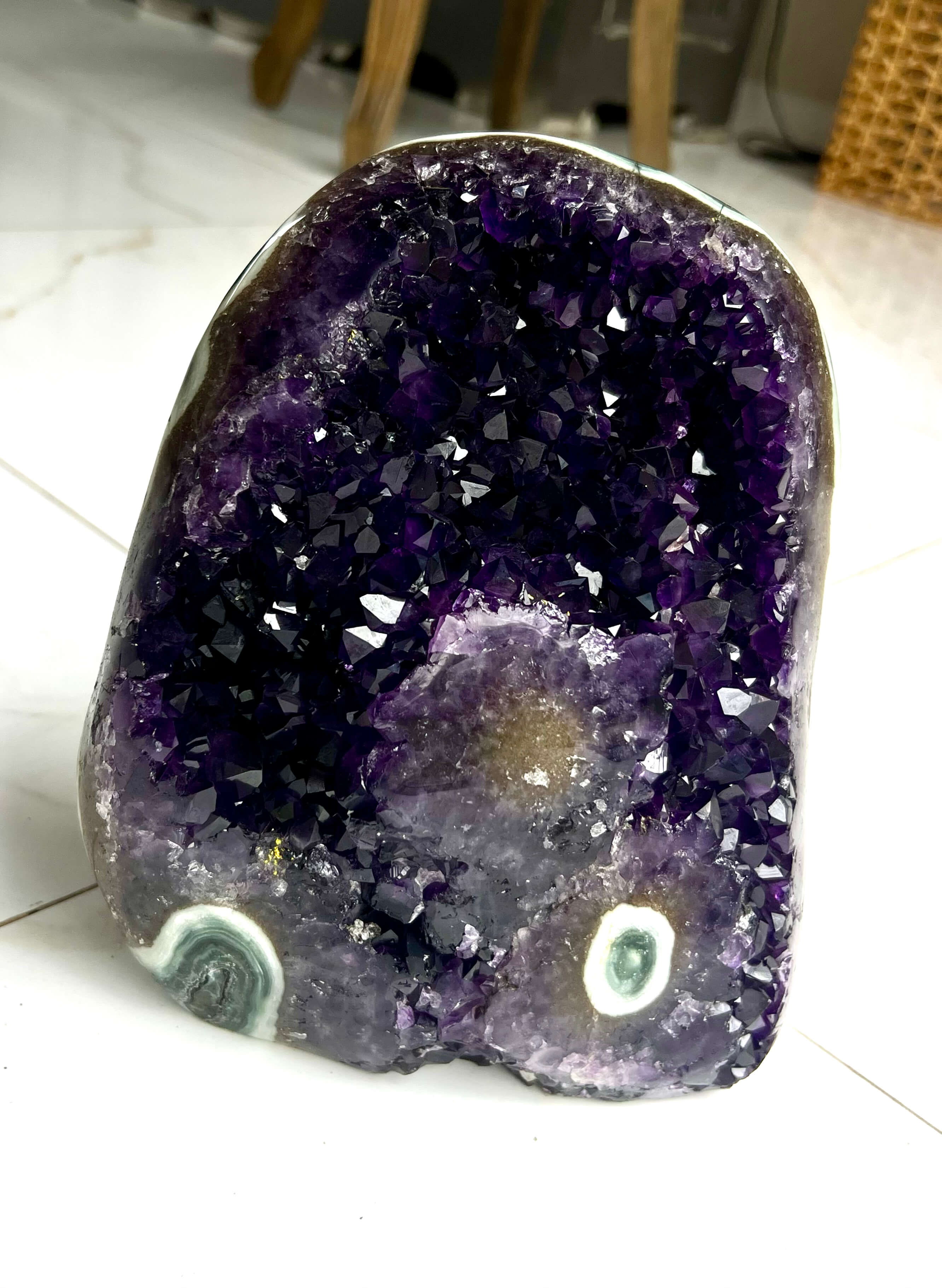
Our own range shows how these criteria play out in practice. The Twin Agate Eyes - Master P Extra Deep Purple Amethyst (4.65 kg) is listed at €789.00, the Crystal Chalice at €689.00, the Deep Cathedral at €949.00 and the Calcite Crown at €2,450.00.
Amethyst Alternatives for Jewelry: Similar Colors and Gemstones
If you want a violet stone for jewellery rather than a display specimen, amethyst is not your only option.
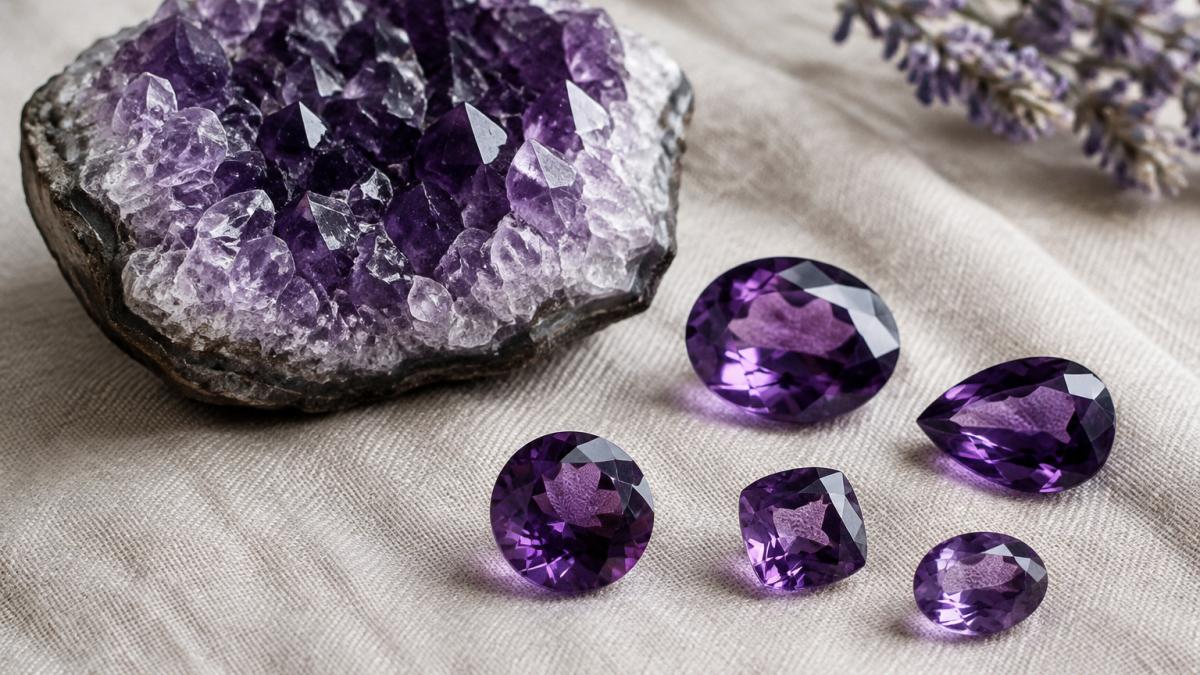
Amethyst scores about 7 on the Mohs hardness scale (Glossary). That is durable enough for most jewellery, but quartz has no cleavage and can chip at sharp facet edges if knocked against a hard surface. If you are worried about treated stones, learn how to tell whether amethyst has been dyed.
Tanzanite, Iolite and Rhodolite Garnet Compared
These three stones are the most common violet alternatives in jewellery, and they behave differently in wear:
- Tanzanite shows a rich blue-violet colour and is typically sold at a higher price than amethyst of the same size. It scores about 6.5 to 7 on the Mohs scale and has one direction of cleavage, so it suits occasional wear better than a daily ring. Its colour can shift between blue and violet depending on the light.
- Iolite is a violet-blue stone that often costs less than tanzanite. It scores about 7 to 7.5 but is softer in practice than amethyst in some directions, and its pleochroism means the colour can shift noticeably with viewing angle, useful in a pendant, less predictable in a ring.
- Rhodolite garnet is a purplish-red stone with good hardness, around 7 to 7.5, and no cleavage, which makes it one of the more forgiving violet-family stones for everyday rings. It differs in colour from amethyst, warmer and redder, but works well in jewellery settings.
Two further options are worth knowing. Sapphire in violet or purple tones is the hardest of the group at 9 on the Mohs scale and the most expensive; it is the choice when durability outranks budget. Spinel in purple tones scores about 8 and sits between amethyst and sapphire on price, though availability in violet is narrower.
Matching the Stone to the Piece
Choose by use rather than by colour alone:
- Daily-wear ring: favour a harder stone with no cleavage, sapphire, spinel or rhodolite garnet, and a secure setting such as a bezel. Amethyst works in a ring if the setting protects the edges.
- Pendant or earrings: colour and price may matter more than hardness, so amethyst, iolite and tanzanite are all reasonable.
- Occasional or dress jewellery: tanzanite's colour shift and iolite's pleochroism become features rather than drawbacks.
- Budget-led purchase: amethyst and iolite generally offer the most colour per euro; lab-created amethyst and violet spinel cost less again but must be disclosed as such.
Price context helps here too. Natural faceted amethyst is among the more affordable violet stones per carat; iolite usually sits close to it, rhodolite garnet a little above, tanzanite and violet sapphire well above.
Care follows hardness. Store amethyst, iolite and tanzanite away from harder stones to avoid surface scratches, clean with warm water and mild soap rather than steam or ultrasonic cleaners, and avoid sudden temperature changes.
Watch out: a "violet amethyst" ring priced far below the natural-stone market is often dyed quartz or glass, ask for the mineral identity, treatment status and, where offered, a stone-specific statement before buying.
Mohs hardness of amethyst alternatives
Genuine Amethyst Identification: What to Check Before You Buy
Before buying any amethyst, examine the listing and, where possible, the piece itself. Genuine amethyst shows natural crystal growth, variation in colour and fine crystal points. Glass or dyed imitations often show uniform colour, bubbles or an unnaturally perfect surface.
Ask the seller direct questions:
- Is the stone natural, treated, lab-created or imitation?
- Is the colour natural, or has it been enhanced?
- Where was the piece mined, and when was it cut or polished?
- Can you send additional photos or measurements of this exact specimen?
Our listings state origin, weight and finish, and we will provide additional photos, dimensions and details on any specific piece before you pay. Any seller who refuses such questions is a warning sign.
Amethyst Certificate of Authenticity and Provenance
A certificate of authenticity records what a seller claims about a stone: its identity, origin and grade. Its value depends on who issues it and whether it refers to the exact piece you are buying. A certificate that is generic, unsigned or not tied to a serial or SKU tells you little.
When comparing sellers, ask whether a certificate is available and what it covers. For Terrae Purpura specimens, each listing carries a SKU, such as TP-SPECIMEN-031 for the Twin Agate Eyes piece, so you can match documentation to the stone you receive.
How to Buy Amethyst Online Safely, Including Secure Payment for Gemstones
Buying a high-value specimen online carries risks: non-delivery, damage in transit, and payment fraud. Reduce them with a few checks before you pay.
- Confirm the total price including shipping and any discount terms. Our bank-transfer option gives a 15% reduction on listed prices, and the adjusted price appears at checkout.
- Check delivery terms. Our specimens ship from Tuscany, Italy, with tracked, insured UPS Express delivery to Germany, usually within 48 to 72 business hours.
- Keep records. Save the listing, the order confirmation, the payment receipt and any correspondence about the specific piece.
- Pay through traceable methods and be cautious of requests to pay through unfamiliar channels.
Use the contact route on the site before buying. Ask about the specific specimen, its weight, its finish and its base. A seller who answers clearly is easier to trust with a large purchase.
Choosing Your Terrae Purpura Amethyst Piece
Terrae Purpura's pieces suit different purposes, so match the stone to your need rather than the highest price:
- For a statement display in a living room or office, the Deep Cathedral (4.85 kg, €949.00) has a dramatic three-dimensional crystal cave.
- For a sculptural centrepiece with a light-catching back, the Crystal Chalice (4.15 kg, €689.00) combines amethyst with a polished agate backing.
- For an entry-level specimen with a distinctive feature, the Twin Agate Eyes - Master P Extra (4.65 kg, €789.00) is notable for its two natural agate eyes.
- For a collector's cabinet piece, the Calcite Crown (23 cm, €2,450.00) pairs a white calcite crystal with a bed of violet amethyst points.
Compare these against the criteria above, check weight and dimensions against the space you have, and ask any seller, including us, the questions that matter most to you.
Frequently Asked Questions
What are the best alternatives to Easterndeity.com for buying amethyst?
Easterndeity.com is one of several gemstone sellers, and the right alternative depends on what you need. For a museum-grade specimen for a collection or a statement piece for a home, compare sellers on documented grading, origin disclosure, return terms and clear pricing. Terrae Purpura offers hand-selected Master P Extra amethyst druses from Artigas, Uruguay, with individual prices from €689.00 to €2,450.00, and 15% off for preferential bank transfer payment. For jewelry, a specialist gem dealer or a jeweller who states stone origin and treatment is usually the more practical choice than a specimen seller.
How can I tell if an amethyst is genuine?
Check the stone under daylight for its colour distribution and look for natural inclusions and growth structures rather than perfectly uniform colour. Ask the seller whether the stone is natural, lab-created or imitation, and whether any treatment has been applied. Glass imitations are often too uniform in colour and show bubbles. A reputable seller will describe the grade, origin and any finishing openly. Ask for a gemmological report for jewellery-grade stones, as it is the most reliable way to confirm identity.
Is a certificate necessary when buying amethyst?
For a decorative specimen, a certificate is useful but not always essential, since you are mainly buying appearance and size. For a jewellery stone or a high-value purchase, a gemmological certificate from a recognised laboratory is worth requesting because it confirms identity and any treatment. A certificate of authenticity from a seller shows what they claim, but it is only as reliable as the seller. Ask what the document covers before paying.
What should I look for when buying amethyst online?
Look for a clear description of origin, weight, dimensions and grade, plus photographs taken in natural light from several angles. Check whether the seller states that the piece is unenhanced and describes any polishing or coatings. Confirm shipping times, insurance and the return policy before you order. For a €789.00 specimen such as The Twin Agate Eyes (4.65 kg), these details matter because the piece cannot be judged accurately from an image alone.
