
Last Updated: November 13, 2026
Quick Summary
Museum grade amethyst is a natural amethyst specimen whose color saturation, crystal clarity, formation and condition meet the standard expected of pieces held in mineral collections or shown in curated displays. The term describes a specimen's overall quality, not a certification issued by any authority, so you verify it yourself by checking color, clarity, crystal coverage, termination sharpness and condition.
- Grading rests on four quality factors: color, clarity, crystal formation and size or weight.
- Color carries the most weight, and even, consistent color across the cavity is rarer and raises grade.
- Dark purple amethyst generally grades higher than light purple because deep saturation is rarer in nature.
- Glass imitations show tiny round air bubbles and curved flow lines under magnification; natural quartz does not.
- A seller who will not put treatment and repair disclosures in writing is the most common warning sign.
Table of Contents
- What Museum Grade Amethyst Actually Means
- The Amethyst Quality Factors That Decide the Grade
- Dark Purple Amethyst vs Light Purple Amethyst
- How to Tell If Amethyst Is Real: A Step-by-Step Checklist
- Amethyst Treatments and Enhancements to Watch For
- Inspecting Condition, Provenance and Display Impact
- Frequently Asked Questions
What Museum Grade Amethyst Actually Means
Museum grade amethyst is a natural amethyst specimen whose color saturation, crystal clarity, formation and condition meet the standard expected of pieces held in mineral collections or shown in curated displays. The term describes a specimen's overall quality, not a certification issued by any authority.
That distinction matters, because the phrase gets used loosely in listings. A dealer can call any geode "museum quality" without proving anything. What separates a genuine museum-grade piece from a dressed-up commercial one comes down to observable factors you can check yourself: depth and evenness of color, crystal transparency, how completely the crystals cover the cavity, the sharpness of the points, and whether the specimen is undamaged.
Below, we walk through each one so you can assess a piece in person or from photographs. For a sense of what the top of that scale looks like, see these small amethyst specimens for display.
The Amethyst Quality Factors That Decide the Grade
Grading an amethyst specimen rests on four quality factors: color, clarity, crystal formation and size or weight. Collectors sometimes call these the four Cs, borrowing from diamond grading, though the criteria differ in practice.
Color carries the most weight. Clarity and crystal coverage decide how the color reads in a room. Formation and size determine display presence. A specimen can score highly on one factor and poorly on another, which is why a single flaw rarely disqualifies a piece and a single strength rarely makes one.
Color Saturation and Zoning
Saturation is the intensity and depth of the purple. Top-grade specimens show a rich, saturated violet that stays dark even under ordinary room light, then flashes brighter where light hits the crystal tips. A deep purple amethyst specimen shows how that saturation reads in practice.
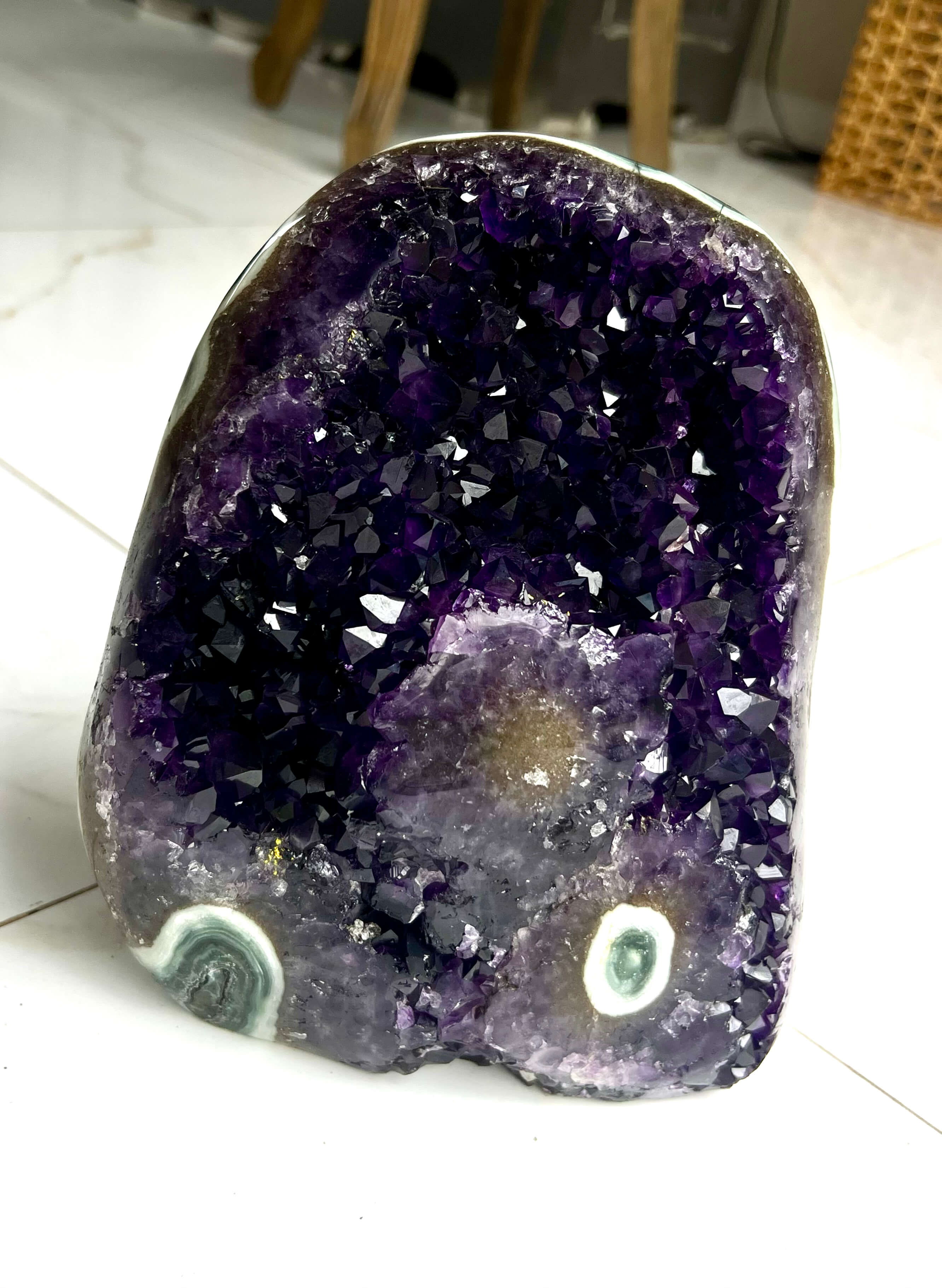
Color zoning is the natural variation in tone across a geode. Most amethyst shows some gradient, darker at the crystal tips and paler near the base, or banded in layers. Even, consistent color across the cavity is rarer and pushes a specimen upward in grade. Heavy zoning is not a defect, but it does affect how uniform the piece looks on display.
Clarity, Crystal Size and Coverage
Clarity refers to how transparent and clean the individual crystals are. Fine specimens have crystals that transmit light rather than appearing cloudy or opaque.
Crystal coverage describes how much of the cavity is filled with well-formed points. Sparse coverage with visible bare matrix lowers the grade. Dense coverage of large, sharply terminated crystals raises it. Crystal size matters too, but only in combination with quality: a few large, clean points beat a cavity packed with tiny cloudy ones.
Dark Purple Amethyst vs Light Purple Amethyst
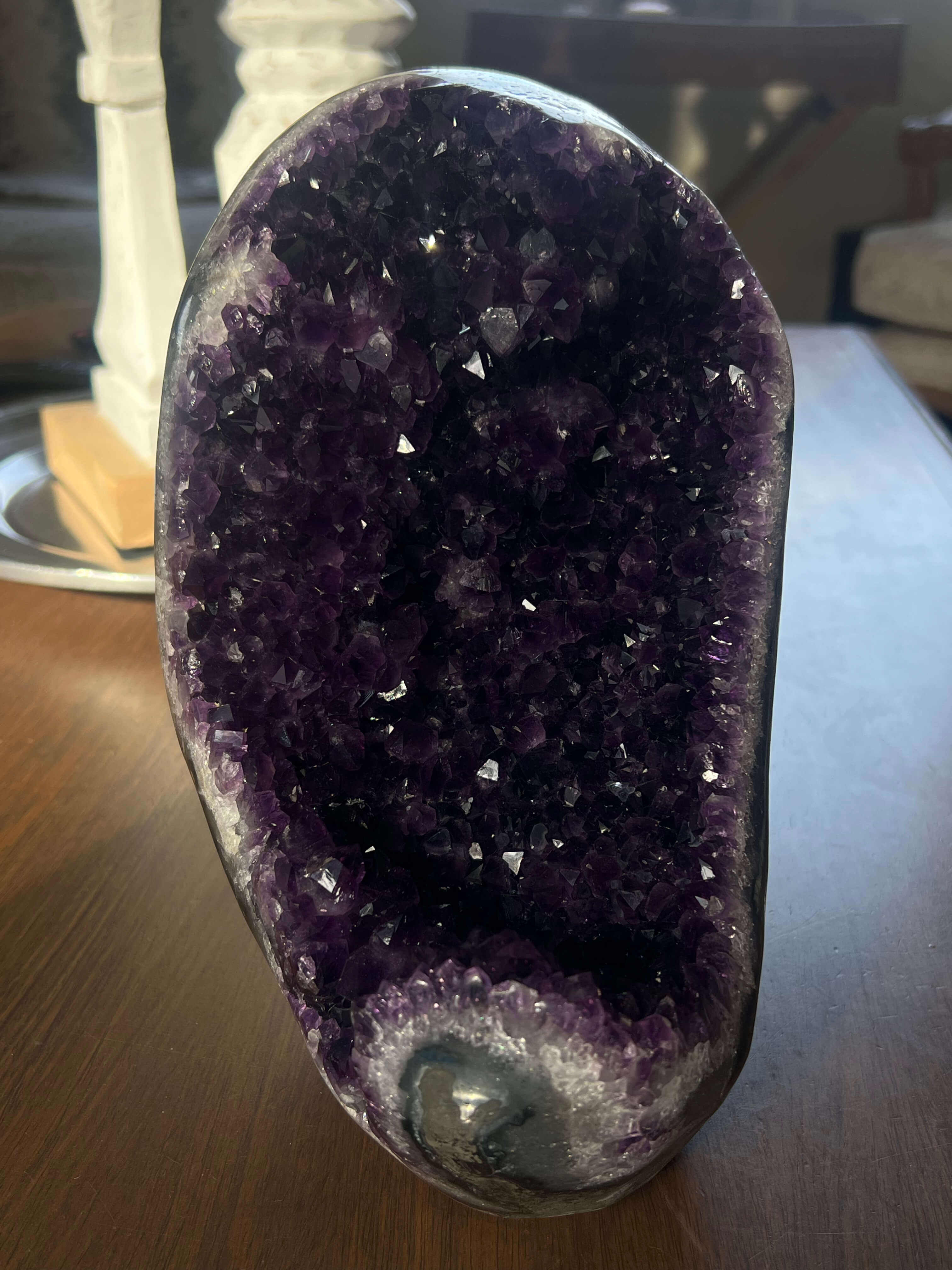
Dark purple amethyst generally grades higher than light purple amethyst because deep saturation is rarer in nature and holds visual impact in a room. Light amethyst can be beautiful, but it reads as pale and washes out under bright interior lighting.
The trade-off is practical. A very dark specimen can look almost black in dim light and only reveal its color under direct sun or a spotlight. Buyers who want a piece to glow in a living room should check how the stone behaves in the lighting where it will actually sit.
If you want to judge the difference for yourself, see an ultra-dark specimen example and compare it against lighter amethyst you have seen in person.
How to Tell If Amethyst Is Real: A Step-by-Step Checklist
Genuine amethyst is natural quartz colored by iron and irradiation in the earth; imitation material is glass, dyed quartz, synthetic quartz, or assembled composite.
Step 1, Establish the base material. Turn the piece over and examine the outer shell.
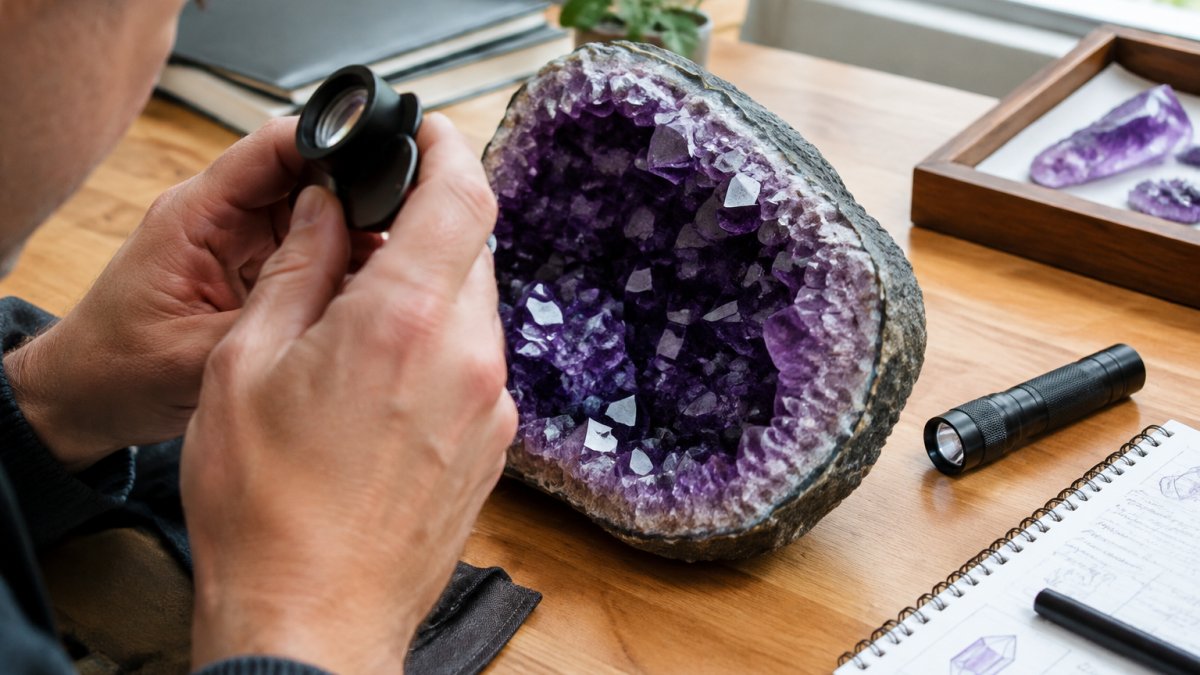
Step 2, Check for bubbles and flow lines. Under magnification, glass imitations show tiny round air bubbles and curved flow lines. Natural quartz does not.
Step 3, Read the color zoning. Natural amethyst usually shows uneven tone, banding, or a gradient from darker tips to paler bases.
Step 4, Examine the terminations. Natural points have irregular, faceted tips with growth striations on the prism faces.
Step 5, Inspect for repairs and assembly. Large geodes are frequently repaired.
Step 6, Test temperature and heft. Quartz feels noticeably cool to the touch and warms slowly; glass and resin warm faster. A geode should also feel dense for its size.
Watch out: dyed specimens often show darker color concentrated along fractures, and assembled pieces can pass a casual look but fail under a torch and loupe.
Work through these checks in good neutral light with a loupe, a small torch and a notebook.
| Step | What to do | What to look for |
|---|---|---|
| 1 | Establish the base material | Natural matrix, agate banding, rough exterior; no seam lines |
| 2 | Check for bubbles and flow lines | Glass shows round air bubbles and curved flow lines |
| 3 | Read the color zoning | Natural shows uneven tone or gradient; dye pools in fractures |
| 4 | Examine the terminations | Irregular faceted tips with growth striations on prism faces |
| 5 | Inspect for repairs and assembly | Glue lines, mismatched color, filler in cracks, unnatural angles |
| 6 | Test temperature and heft | Quartz feels cool and warms slowly; geode feels dense |
| 7 | Ask for provenance and treatment disclosure | Locality and treatments stated in writing, not just asserted |
Amethyst Treatments and Enhancements to Watch For
Heating can lighten an overly dark piece or push it toward citrine tones. It is widely accepted in the trade, but it should be disclosed.
Dyeing and coating are the treatments that should concern a collector. Dye soaks into surface cracks to deepen color; coatings add a purple film that wears off.
Irradiation is used commercially to darken pale material. It is difficult to detect without laboratory equipment, which is why documentation matters more than any home test.
Repair and assembly are the treatments most often missed on large geodes. Look for glue lines at the matrix, mismatched color between adjacent clusters, filler in cracks, and points that sit at unnatural angles.
For remote purchases, ask for photographs under neutral daylight, a scale reference, close-ups of the terminations, and views of the back and base. Request the same views under a torch to reveal fillers and coatings.
Watch out: a seller who will not put treatment and repair disclosures in writing is giving you information you cannot verify, and that is the single most common warning sign in a high-value geode purchase.
Inspecting Condition, Provenance and Display Impact
Condition decides whether a specimen holds its value. Check every crystal tip for fractures, chips and repairs; a single broken point on a prominent crystal can halve a piece's appeal. Restoration is common in large geodes, and honest sellers disclose it.
Provenance means the documented origin of the stone. For amethyst, the locality is the headline: Artigas in Uruguay is prized for dense, saturated crystal. A seller who can trace a specimen to a specific mining region is giving you something a vague "from Brazil" line never does.
Display impact is the final test. Stand back and ask whether the piece commands the space it will occupy. If you are furnishing a specific spot, browse monumental cabinet specimens to judge how matrix and height change the effect.
Judging a specimen on color, clarity, formation and condition takes an afternoon of practice, and it will save you from an expensive mistake. The harder part is finding material that genuinely meets the bar. Terrae Purpura sources museum-grade Q1 deep purple amethyst from Uruguay, hand-polishes each piece, and ships free within the EU by express courier in 48 hours.
Frequently Asked Questions
What makes an amethyst museum grade?
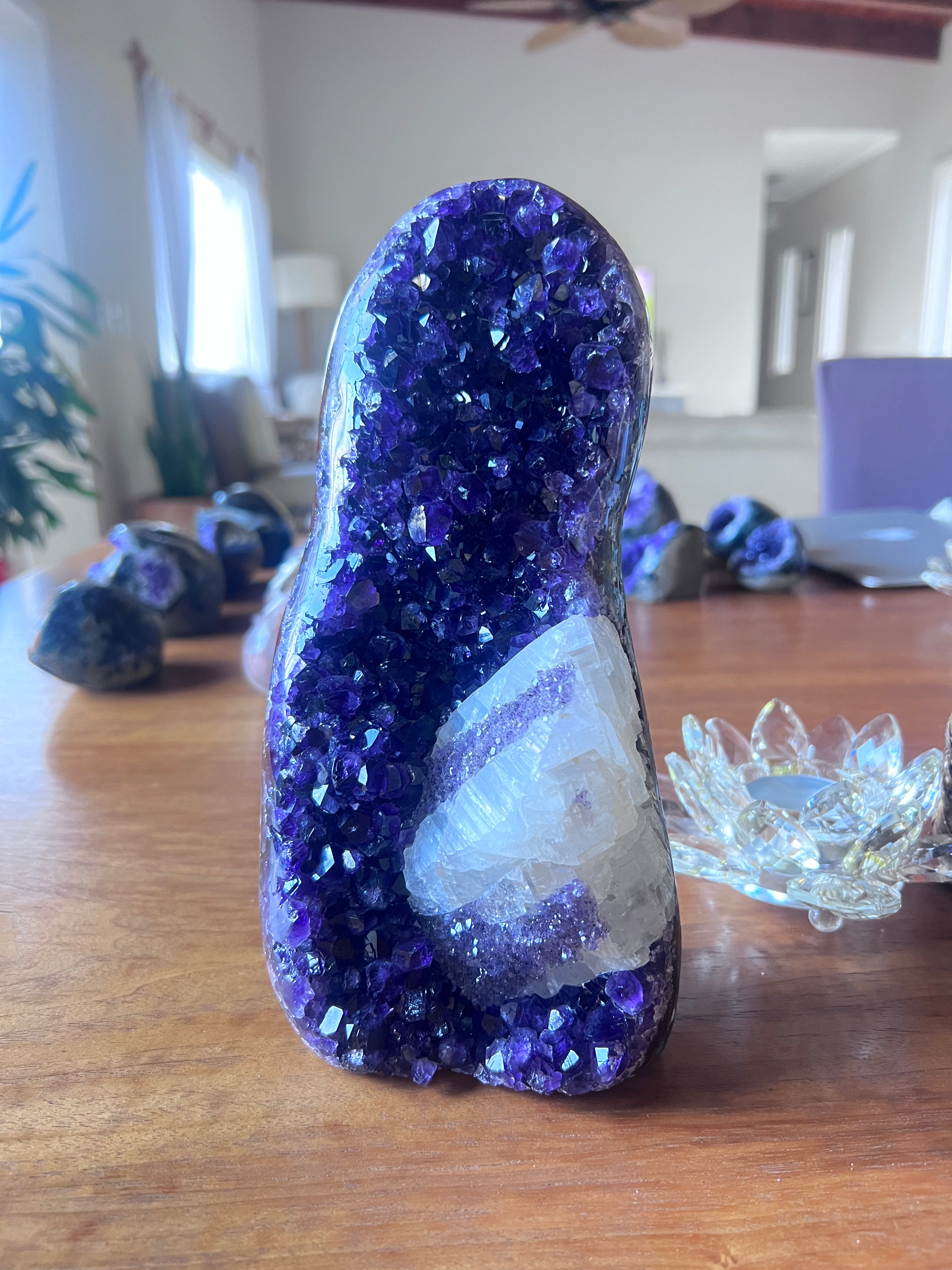
Museum grade amethyst combines deep, saturated purple color with minimal zoning, strong transparency, large well-formed crystal points and high crystal coverage across the geode. The specimen should be free of fractures and damage, sit on an attractive matrix, and have documented origin. Size and display impact matter too: a 23 cm cabinet specimen such as The Calcite Crown, with a pristine calcite crystal on a saturated amethyst bed, shows the combination of color, structure and condition that separates museum grade from commercial druse.
Is dark purple amethyst more valuable than light purple amethyst?
Yes, in most cases. Deep, saturated violet, often called deep purple or Extra AAA, commands higher prices than pale lavender because the color is rarer and more stable across lighting. Deep violet material can read almost black-violet under room light and flash brighter in sunlight. Pale stones can still be beautiful, but they rarely reach museum grade. When comparing dark purple amethyst vs light purple amethyst, check saturation in both diffuse and direct light before deciding.
How can you tell whether amethyst has been heat-treated?
Heat treatment is common in amethyst sold as citrine, but it is also used to even out color in some amethyst. Look for unnaturally uniform color with no zoning, a slightly brownish or reddish undertone, and color that looks identical under every light angle. Natural deep purple amethyst usually shows subtle zoning and shifts between diffuse and direct light. Ask the seller directly about treatments and request written confirmation. Reputable dealers disclose heat treatment, and a specimen with clear natural zoning is a strong sign it has not been altered.
What should you check before buying a museum-quality amethyst?
Work through a checklist: color saturation and zoning, clarity, crystal size and coverage, condition (no chips or fractures), matrix and associated minerals such as calcite, and provenance documentation. Ask for photos in both diffuse and direct light, plus close-ups of the crystal tips and the base. Confirm the stated height and weight in centimetres and kilograms, and check the return policy. For remote purchases, request a short video turning the piece so you can judge depth and any restoration work.
