
Last Updated: November 10, 2026
Quick Summary
You can tell if amethyst is real by examining its colour in daylight, looking for natural zoning and inclusions, and checking for trapped round bubbles that suggest glass. Simple home checks give clues but not proof, so a laboratory report is the only dependable confirmation for a high-value stone.
- Natural amethyst often shows colour zoning, bands of lighter and darker purple, rather than perfectly even colour.
- Round bubbles or swirl lines inside the stone are a strong sign of manufactured glass.
- Natural quartz tends to feel cool against the skin for longer than glass, though this is only a rough guide.
- Avoid scratch tests on finished or mounted pieces, since a scratch is permanent.
- For a significant purchase, get a laboratory report and ask the seller for treatment disclosure in writing.
Table of Contents
- What Genuine Amethyst Looks Like Before You Test It
- Checking Color, Zoning and Clarity Under Bright Light
- Amethyst Glass vs Real: Bubbles, Temperature and Feel
- Spotting Dyed Amethyst and Treatment Disclosure
- Running a Safe Amethyst Hardness Test at Home
- Booking Lab Verification Before You Buy a High-Value Piece
- Frequently Asked Questions
What Genuine Amethyst Looks Like Before You Test It
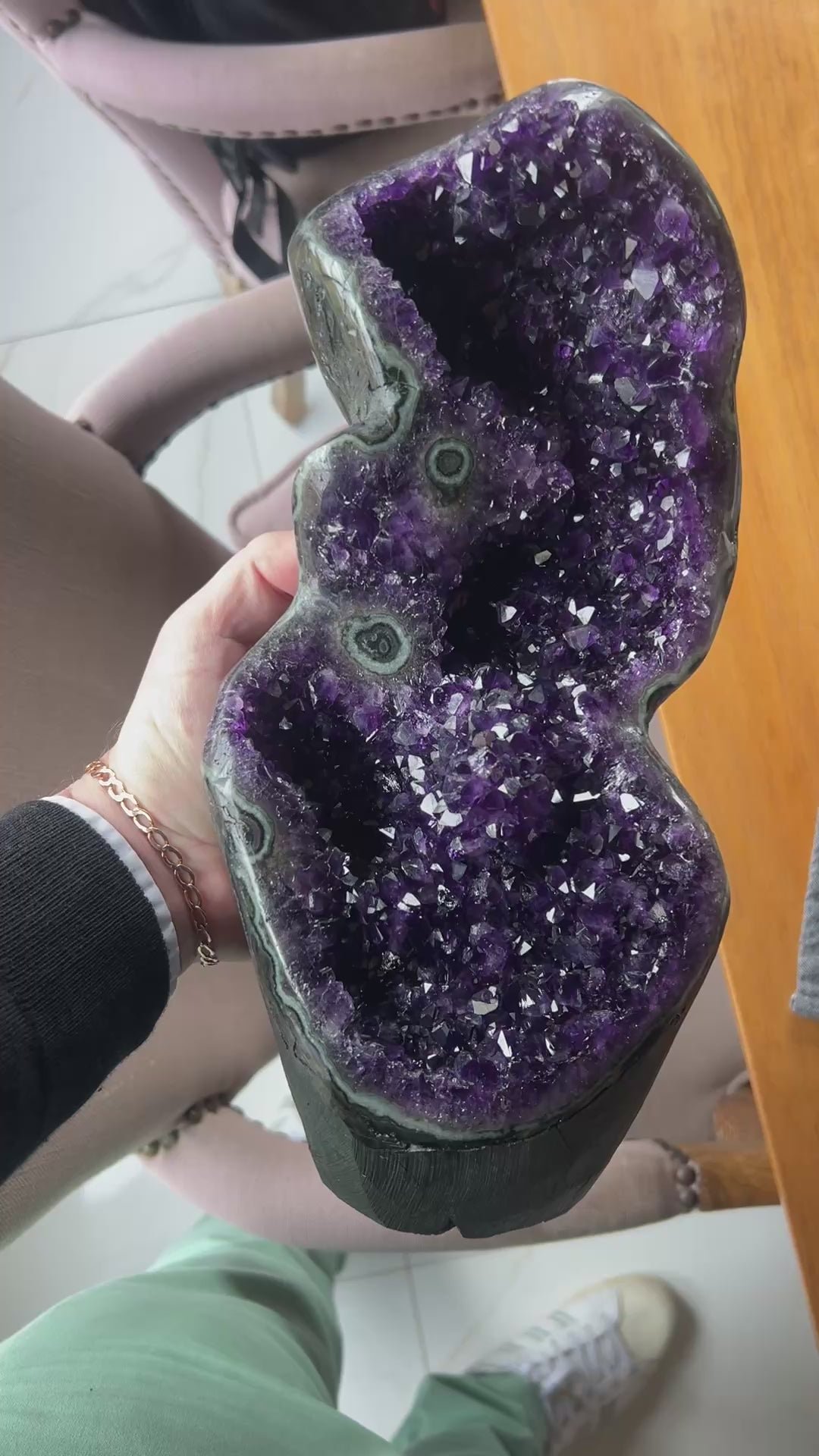
When you learn how to tell if amethyst is genuine, start by noticing that it usually shows deep, even purple with some natural colour variation, and it rarely looks like perfect glass. Many buyers find that the first step is simply learning what a real stone looks like in good light before running any test. Amethyst druses and geodes from Artigas, Uruguay, are often sold with a range of finishes, and a stone that looks too uniform is worth a closer look.
Gemological Institute of America overview of gemstone identification explains that identification relies on a combination of visual and physical properties, not a single test. That is the approach this guide takes.
Quick checks before any test:
- Look at colour in both daylight and indoor light
- Check for uneven patches, which are common in natural stone
- Note any bubbles, swirls or perfectly smooth areas
- Compare the crystal points to each other for natural variety
Checking Color, Zoning and Clarity Under Bright Light
Bright, indirect daylight shows the most about a stone's colour. Turn the piece slowly near a window and watch how the purple shifts across the crystal faces.
Natural Color Zoning and Uneven Tones
Natural amethyst often shows colour zoning, meaning bands or patches where the purple is lighter or darker. This is a sign of natural growth, not a fault, and it is one of the clearest ways to tell if amethyst is real. A stone with perfectly identical colour everywhere deserves a second look.
Watch out: Zoning can be mistaken for dye or the reverse, so colour alone never settles the question.
Amethyst Inclusions: Natural Marks Versus Warning Signs
Small internal features, called inclusions, are a normal part of natural quartz. Fine tension cracks, small mineral spots and feathery patterns usually indicate a natural origin. Perfectly clean glass-like clarity, especially in a large piece, is less typical and deserves scrutiny.
Amethyst Glass vs Real: Bubbles, Temperature and Feel
Glass imitations are the most common fakes sold as amethyst. Round or oval bubbles trapped inside the stone are a strong sign of glass, because natural quartz does not form them.
- Round bubbles or swirl lines suggest manufactured glass
- Natural quartz feels cool to the touch for longer than glass
- Glass often looks too clean and evenly coloured
- Natural crystal points show irregular, faceted growth
Some people use a simple temperature check: hold the stone against the skin for a few seconds. Natural quartz tends to feel cool for longer than glass, though this is only a rough guide. This test is only a guide, so combine it with visual checks.
Spotting Dyed Amethyst and Treatment Disclosure
Dyed or heat-treated stones are sold in volume, and the signs can be subtle. Dye often pools in cracks and crevices, leaving colour concentrated in small fractures while the surrounding area looks paler. Ask any seller directly whether a stone has been treated, and ask for that answer in writing. You can browse our untreated Artigas geodes to see how natural specimens are described.
A reputable seller should disclose enhancement clearly. If a listing is vague about treatment, treat that as a reason to walk away.
Running a Safe Amethyst Hardness Test at Home
A scratch test is the most-cited home check, but it is also the one most likely to cause harm. Amethyst sits at about 7 on the Mohs hardness scale, which is why a steel blade generally will not mark it while quartz can scratch glass. That difference is real, but it is a weak basis for a verdict, and it is a poor test to run on anything you own and value.
Start with safer checks first. Examine the stone under bright indirect light, compare its colour zoning and inclusions with the other clues in this guide, and feel its temperature against your skin. These steps cost nothing and leave no marks.
Do not run a scratch test on a finished piece, on any stone set in jewellery, or on anything you cannot afford to mark. Settings can be damaged, coatings can be removed, and a single scratch on a polished surface is permanent. If the stone is mounted, skip the test entirely.
If you do test a loose, unmounted specimen you are willing to risk, use the mildest approach that answers the question. Work only on a small, hidden, unpolished area, and use a material of known hardness rather than a sharp tool that could chip the crystal.
Watch out: A scratch can be caused by a grain of dust, a worn file, or an uneven surface, so a single mark does not prove that a stone is glass or quartz.
The result is also not definitive. Glass imitations, dyed stones, and treated materials can behave similarly under a casual scratch test. Treat hardness as one clue among several, never as proof of origin.
The article's home checks, with what each one involves and its limits:
| Check | What to do | Limit |
|---|---|---|
| Colour under daylight | Turn the stone near a window | Zoning can mislead |
| Bubbles or swirls | Look for round bubbles inside | Only suggests glass |
| Temperature feel | Hold against skin a few seconds | Only a rough guide |
| Scratch test | Test a small hidden, unpolished area | Can permanently mark the stone |
| Lab verification | Get a report for high-value pieces | Lab must be recognised |
Booking Lab Verification Before You Buy a High-Value Piece
Home checks have clear limits. Visual clues and simple tests can suggest that a stone is glass or heavily treated, but they cannot reliably separate every natural, synthetic, treated, or imitation material. For a significant purchase, a laboratory examination is the only dependable way to confirm identity, origin, and treatment. Gemological laboratory guidance on identifying gemstones describes the kind of professional identification that these labs perform.
It helps to separate three categories that are often confused. Natural amethyst is quartz that formed in the ground. Lab-grown amethyst is also quartz, but it was grown in a controlled process rather than mined. Treated or dyed amethyst is natural or lab-grown quartz whose colour has been altered, and it should be disclosed as such. Glass and other imitations are a different material altogether. A lab report can tell you which of these you are dealing with.
An independent appraisal or lab report is usually worth the cost when the piece is expensive, when the seller's documentation is thin, or when you plan to resell or insure it. For a low-value specimen, the expense may exceed the value of the stone, and careful visual inspection plus a reputable seller may be enough.
Before you pay, ask the seller specific questions. Ask whether the stone is natural, lab-grown, treated, or imitation, and ask for that answer in writing. Ask what treatment, if any, has been applied and whether it is permanent. Ask for any lab report or provenance records, and check whether the listing says where the stone was mined or grown.
Check the return policy before buying. A seller who will accept returns after independent testing is giving you a meaningful safeguard, while a no-returns policy on a high-value item shifts the risk entirely onto you.
Watch out: A certificate is only as useful as the laboratory that issued it, so confirm that the lab is recognised and that the report describes the specific stone you are buying.
You can read more about our sourcing and seller details on our about us page, or send questions about a specific specimen through our contact page.
Frequently Asked Questions
How can you tell if amethyst is real at home?
Start with a visual check under bright daylight. Genuine amethyst usually shows uneven color zoning, with darker and paler bands, and natural inclusions rather than perfectly uniform tone. Next, feel the stone: real quartz stays cool to the touch for longer than plastic or glass. Finally, look for bubbles or swirl patterns, which point toward glass. None of these tests is conclusive alone, so treat a combination of signs as the basis for judgement, and use a lab certificate for any high-value purchase.
Does real amethyst change color in sunlight?
Amethyst can look lighter or more vivid in direct sunlight, and under strong artificial light it may appear darker. This shift is a normal optical effect of the crystal's color and internal structure, so a change in appearance alone does not prove a stone is fake. Compare the specimen under the same light source from several angles, and look for the zoning and inclusions that are hard to imitate convincingly.
Can a scratch test prove that amethyst is real?
A scratch test is not a reliable proof. Amethyst rates about 7 on the Mohs hardness scale, and many glass imitations score close to it, so a scratch result can mislead. Testing also risks damaging a valuable piece, especially on polished surfaces or jewellery settings. Use the test only on an inconspicuous area of a stone you own, and rely on a gemmological examination for any decision that matters.
When should you get an amethyst professionally tested?
Get a professional examination whenever the piece is expensive, is being bought as an investment, or comes with an unclear origin. A gemmologist can use magnification, refractometry and spectroscopy to separate natural from synthetic or treated material, and can detect dye or heat treatment that home checks miss. Ask the seller for documentation of origin and any treatments, and keep that paperwork with the specimen.
