
Last Updated: November 8, 2026
Quick Summary
Shipping mineral specimens safely means wrapping each piece in acid-free tissue and bubble wrap, filling every gap so nothing shifts, and placing it in a snug individual box sealed on all seams. Double box fragile minerals with at least five centimetres of cushioning on every side, then shake the closed box and add void fill if you hear movement.
- Label the inner box fragile before it goes into the outer carton.
- A loose inner box is the most common cause of breakage in transit.
- Photograph the wrapped specimen, loaded inner box and sealed outer box with the label visible.
- Declare the full value and choose a carrier with tracking and signature confirmation.
- Many carriers require damage to be noted at delivery or within 24 to 72 hours.
Table of Contents
- How to Pack Mineral Specimens for Shipping
- Double Boxing Fragile Minerals for Extra Protection
- Documenting Mineral Specimens Before Shipping
- Mineral Specimen Shipping Insurance and Carrier Choice
- Frequently Asked Questions
How to Pack Mineral Specimens for Shipping
Shipping mineral specimens starts with treating every piece as both fragile and irreplaceable. Shipping mineral specimens starts with treating every piece as both fragile and irreplaceable, and a safe arrival depends on one habit: pack the crystal, not the box.
- Wrap each specimen in acid-free tissue, then a layer of bubble wrap.
- Fill every gap with foam or newsprint so nothing shifts.
- Place the wrapped piece in an individual box that fits snugly.
- Seal the inner box with tape on all seams.
- Label the inner box "fragile" before it goes into the outer carton.
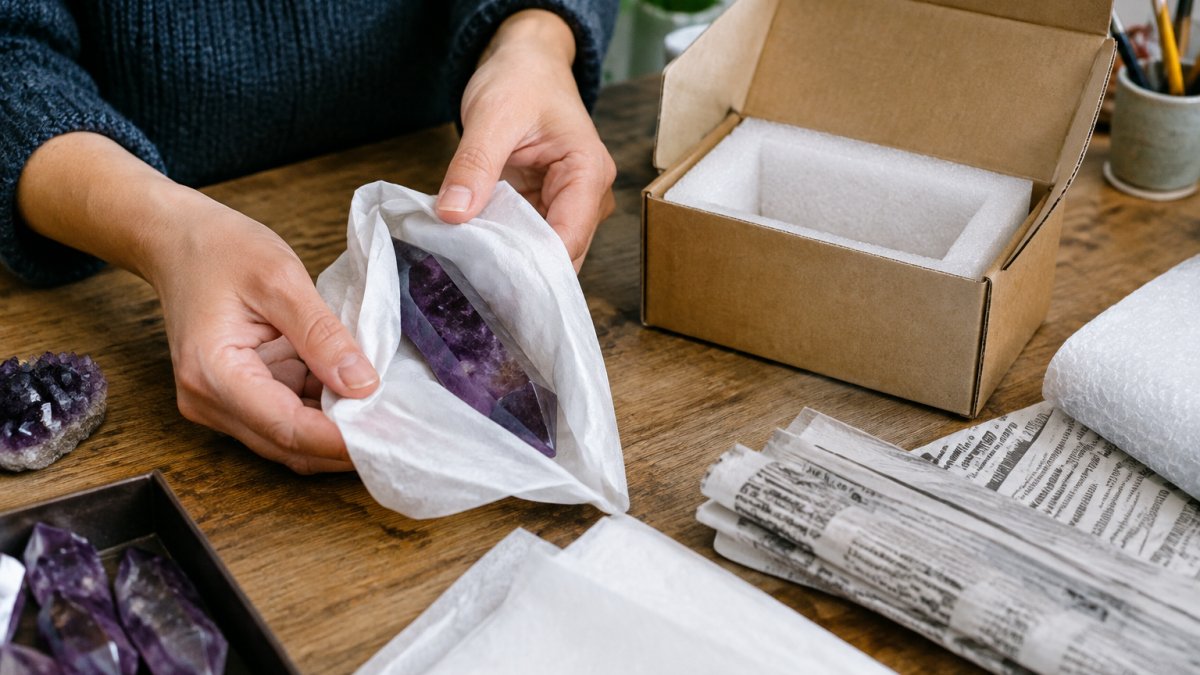
The individual box is the step most guides skip. A specimen that can move inside its own box will hit a wall, no matter how much padding surrounds it. Browse the complete gallery to see the specimens we pack this way.
Double Boxing Fragile Minerals for Extra Protection
Double boxing fragile minerals means placing the sealed inner box inside a larger outer box, with at least five centimetres of cushioning on every side. The outer box takes the hit; the inner box keeps the specimen still.
Use a hard-shell outer carton, not a thin mailer. Fill the gap with foam, air pillows or crumpled newsprint. Shake the closed box before sealing it. If you hear movement, add more void fill.
Watch out: a loose inner box is the most common cause of breakage in transit. Nesting must be tight on all six sides.
Specimen-specific double-boxing decisions
Crystal points and terminated crystals. The risk is point breakage and edge chipping. Wrap the point in acid-free tissue, then a foam collar or a foam block with a carved recess so the point sits in a cradle.
Matrix specimens (specimens on host rock). The risk is the matrix cracking or the crystal separating from it.
Soft or friable minerals. The risk is abrasion and surface loss. Avoid bubble wrap directly against the surface; use acid-free tissue or a soft foam pouch without compressing it.
Large or unusually shaped pieces. The risk is the specimen bridging the box and taking the impact directly.
Heavy geodes. Heavy geodes need double-boxing every time, plus a weight-rated outer carton. Check the carton's maximum load, keep the geode centred, and use dense foam rather than air pillows, which collapse under weight. See the masterpiece geodes that demand double-boxing every time.
A repeatable packing test before sealing
Before the outer box is sealed, run the same three checks on every shipment:
- Movement check. Shake the closed outer box gently. Any shift means add void fill and re-check.
- Weight check. Weigh the parcel and confirm it is within the carrier's limit and that the outer carton is rated for that load.
- Photo check. Photograph the wrapped specimen, the loaded inner box, and the sealed outer box with the label visible. Keep these with the tracking number, they are the evidence base for any insurance claim.
Documenting Mineral Specimens Before Shipping
Documenting mineral specimens before shipping protects both buyer and seller. Photograph each piece from several angles under good light. Note weight, dimensions, matrix details and any natural edges. Record the declared value and keep the images with the tracking number.
This record supports an insurance claim if damage occurs and gives the buyer proof of condition before transit. Many collectors also keep it for provenance.
We document every 1/1 piece before it leaves, and you can read more about us and how each certified specimen is handled.
Mineral Specimen Shipping Insurance and Carrier Choice
Mineral specimen shipping insurance is worth considering for high-value pieces, but the policy wording matters more than the checkbox. Declare the full value, keep the receipt, and choose a carrier with tracking and signature confirmation. Compare services on cost, speed and claim handling, not price alone.
Matching service level to specimen value
Let the declared value drive the service tier. Let the declared value of a piece guide the service level you choose. Higher-value pieces generally warrant express, signed-for delivery with full declared-value insurance, and irreplaceable pieces may justify a carrier that handles fine art or high-value freight.
| Shipment Type | Service Level | Insurance | Best For |
|---|---|---|---|
| Standard crystal | Tracked parcel | Declared value | Mid-range pieces |
| High-value specimen | Express, signed | Full declared value | Museum-grade pieces |
| International | Express, customs docs | Full declared value | Cross-border sales |
What insurance actually covers, and what it excludes
Most carriers insure against loss and physical damage in transit, but the exclusions are where claims fail. Common exclusions include:
- Insufficient packaging. A carrier can reject a claim if the outer box shows no external damage but the specimen is broken, that is a packing failure, not a transit failure.
- Concealed damage reported late. Many carriers require damage to be noted at delivery or within 24-72 hours. Photograph the unopened and opened parcel before unpacking further.
- Improper declaration. Under-declaring value to save on premium voids cover for the real value. Declare what the piece is worth and keep the invoice or valuation to prove it.
- Prohibited or restricted contents. Some minerals and fossil materials face import or export restrictions; a shipment seized by customs is generally not an insured loss.
Watch out: a claim is only as strong as the pre-shipment record. Photograph condition, packing, and the sealed box before it leaves, and keep those images with the tracking number.
Carrier and service comparison for high-value shipments
Rather than naming carriers, compare them on the criteria that actually affect risk:
- Tracking granularity. Look for end-to-end scanning, not just depot-to-depot.
- Signature requirement. Signed-for delivery, ideally with ID check, prevents porch theft and misdelivery.
- Handling limits. Check maximum dimensions and weight, and whether the service accepts fragile or high-value goods.
- Insurance terms. Confirm the maximum declared-value limit per parcel and whether the carrier insures minerals and fossils specifically.
- Claim process. Ask how a claim is filed, what evidence is required, and typical resolution time before you ship.
- Delivery speed. Faster transit means fewer handling events; for fragile pieces, speed is a risk control, not a luxury.
Customs paperwork and international restrictions
For international shipping, prepare customs paperwork in advance and check restrictions. Describe contents accurately and specifically (for example, "mineral specimen, amethyst, for collection" rather than "gift" or "stone"), declare the true value, and attach the commercial invoice and any required certificates. Check whether the destination country restricts or requires permits for the mineral type, and confirm the recipient's details are complete.
Weather and timing
Avoid shipping in extreme heat or cold where possible, and avoid holding a parcel in a depot over a weekend or public holiday. If a heat-sensitive or water-sensitive specimen must travel, choose a faster service and confirm the recipient will be available on the delivery day.
Have a question about a specific piece? Contact us for photos, dimensions and shipping details before you order.
Shipping a valuable crystal safely comes down to preparation, not luck. At Terrae Purpura, every museum-grade Q1 deep purple amethyst is hand-polished, documented and shipped directly from Tuscany with free 48-hour DHL Express delivery within the EU. Preferential bank transfer payment saves 15% instantly. Get started with Terrae Purpura and receive your specimen in perfect condition.
Frequently Asked Questions
How much padding does a mineral specimen need?
Enough that the specimen cannot shift when you shake the closed box gently. Wrap the piece first, then fill every gap around it with newsprint, foam or bubble wrap so the specimen sits suspended rather than resting on the box floor. A good rule: if you can hear or feel movement, add more cushioning. For fragile crystal points and matrix pieces, keep at least two to three centimetres of padding on every side, and place the heaviest part of the specimen toward the bottom of the box.
Can you ship mineral specimens internationally?
Yes, and within the EU, intra-community shipments generally move without customs duty. Shipments leaving the EU need a commercial invoice, a precise description of the specimen and its declared value, plus any permits required for restricted materials. Always use tracked, signed-for services, avoid P.O. Box delivery, and check the destination country's import rules before dispatch. Terrae Purpura ships its specimens from Tuscany with free 48-hour DHL Express delivery inside the EU.
What should you do if a mineral specimen arrives damaged?
Photograph the unopened parcel, the packaging and the damage before moving anything, then keep all packing materials until the claim is settled. Report the damage to the carrier within its stated deadline and submit your pre-shipment photos and declared value as evidence. This is why documenting mineral specimens before shipping matters: condition photos taken before dispatch are the strongest proof that the damage happened in transit. Never discard the box, because inspectors may ask to see it.
