
Last Updated: November 16, 2026
Quick Summary
The best amethyst for luxury home decor is a museum-grade specimen with deep, saturated color, natural crystal formation, and verified provenance, not a dyed commercial piece. We source Q1 deep purple amethysts from Artigas, Uruguay, and hand-polish each one before shipping from our Tuscan warehouse.
- Our shortlist ranges from a compact 665 g dome to a 23 cm cabinet specimen.
- Anything above roughly four kilograms belongs on a floor-standing plinth or reinforced surface.
- The Calcite Crown is the highest-priced piece in the comparison at €2,450.
- Keep pointed specimens above 90 cm from the floor in households with small children or large dogs.
- Free express delivery arrives within 48 to 72 business hours, fully tracked and insured.
Table of Contents
- Why Amethyst Belongs in Luxury Interiors
- The Best Amethyst for Luxury Home Decor: A Quick Comparison
- Choosing an Amethyst Geode for Home Decor
- How to Style Amethyst in a Living Room
- The Right Amethyst Display Stand for Every Piece
- Shipping Boxes for Mineral Specimens: What to Expect
- Care, Cleaning, and Long-Term Maintenance
- Reserving Your Museum-Grade Amethyst
- Frequently Asked Questions
Why Amethyst Belongs in Luxury Interiors
The best amethyst for luxury home decor is a museum-grade specimen with deep, saturated color, natural crystal formation, and verified provenance, not a dyed commercial piece. At Terrae Purpura, we source Q1 deep purple amethysts from Artigas, Uruguay, and hand-polish each one before shipping from our Tuscan warehouse.
Amethyst earns its place in high-end interiors because it does something mass-produced decor cannot: it holds genuine geological history. A deep violet geode brings color, texture, and structure to a room in a single object, and it functions as both focal point and conversation piece.
Below, we compare our finest specimens, explain how to judge quality before you buy, and show you how to place, light, and maintain a piece so it looks as good in five years as it does on arrival.
The Best Amethyst for Luxury Home Decor: A Quick Comparison
Our shortlist ranges from a compact 665 g dome to a 23 cm cabinet specimen, and each piece suits a different room and budget. The table below sets out weight, price, and best placement so you can match a specimen to your space before reading the detail.
| Specimen | Price | Best Placement |
|---|---|---|
| The Alabaster Violet Dome | €349 | Desk, shelf, bedside |
| Artigas Deep Violet Heart | €399 | Console, credenza |
| The Sovereign Duet (pair) | €730 | Symmetrical shelving |
| The Twin Agate Eyes | €789 | Central coffee table |
| The Sovereign Midnight Eclipse | €890 | Entry console |
| The Deep Cathedral | €949 | Living room centerpiece |
| The Executive Triptychon | €1,158 | Executive desk, glass shelving |
| The Calcite Crown | €2,450 | Cabinet display, gallery niche |
Price
How to Read the Comparison Table
Start with weight, because it sets the practical limit on where a piece can safely stand. Anything above roughly four kilograms belongs on a floor-standing plinth or a reinforced surface, never a floating shelf.
The Calcite Crown is the highest-priced piece in this comparison and the Alabaster Violet Dome the lowest, as listed in the table above.
If you are furnishing a single focal wall, buy one large piece. If you are layering a shelf or console, the Sovereign Duet or the Triptychon gives you a composed set instead of a lone object.
Choosing an Amethyst Geode for Home Decor
An amethyst geode for home decor should be judged on four things: color saturation, crystal definition, the finish of the outer rind, and honest documentation of where it came from. Get those right and the piece will hold its presence for decades.
Color is the first filter. Top-grade Artigas material shows a deep, almost black violet in ambient room light, then flashes vivid purple and magenta when direct sun or a spot light hits the crystal points.
Finish matters just as much. A hand-polished agate rim creates a mirror border that frames the crystal cave. Ask directly whether any piece has artificial coloring, lacquer, or resin filling before you buy.
If you want to verify grade before committing, our guide on how to identify museum grade amethyst walks through the visual checks in detail.
Size, Color, and Provenance Checklist
Use this checklist before you pay for any specimen:
- Weight recorded in grams or kilograms, stated on the listing
- Color photographed in natural light, with no purple filter or colored lamp
- Crystal points intact, with no obvious fractures or cloudy tips
- Outer rind hand-polished, not painted or lacquered
- No cement or resin backing on the reverse
- Origin named down to the mining region, not just the country
- Grade stated, for example Q1 or Extra AAA
- Return and damage-insurance terms in writing
Provenance is the item buyers skip and later regret. The origin of a specimen is an important detail to ask about, and each Terrae Purpura piece is sourced from Artigas, Uruguay.
If you are working with a smaller space or budget, our selection of small amethyst specimens for display shows how compact pieces can still read as museum-grade.
How to Style Amethyst in a Living Room
Styling amethyst in a living room comes down to one rule: give the specimen a defined stage and let it be the only bold object in that sightline.
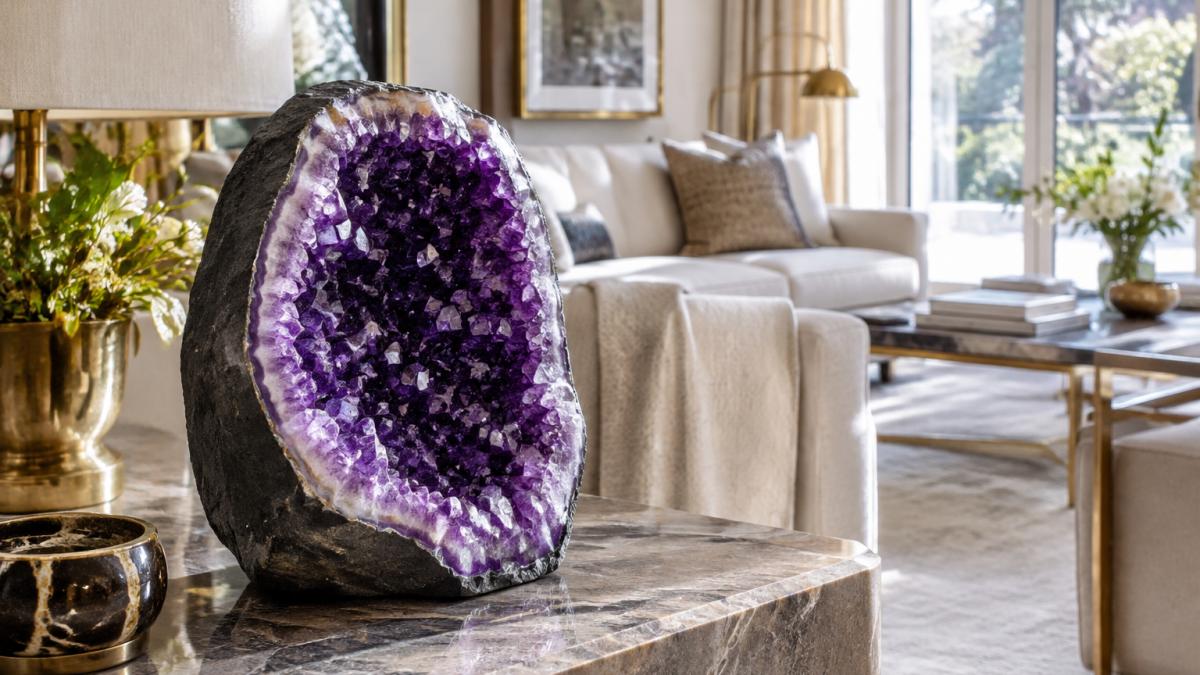
Place the piece on a console, sideboard, or low plinth where it sits at or slightly below eye level when you are seated.
Pair it with materials that stay quiet: linen, travertine, aged brass, dark wood. A single rose quartz or copper wire accent nearby can echo the warm tones in the amethyst without fighting it.
Lighting does the rest. Position the specimen near a window for that daylight color shift.
For more statement-piece ideas that work as decor focal points, browse our hand polished amethyst statement pieces.
The Right Amethyst Display Stand for Every Piece
An amethyst display stand should match the base of the specimen, not its weight class alone.
- Self-standing pieces: the Twin Agate Eyes and Midnight Eclipse sit on their own cut base, so a simple felt pad protects the surface underneath and prevents micro-scratches on lacquered or stone tops.
- Heavy specimens above 4 kg: use a low, wide plinth in stone or solid oak. A narrow stand concentrates pressure and invites a tip. As a working guide, the plinth footprint should be at least as wide as the widest point of the geode, and the centre of mass should sit over the middle of the base, not the front edge.
- Pairs and sets: the Sovereign Duet and the Triptychon need a level shelf with even depth so the composition reads as one arrangement. Check the shelf's stated load rating, not just its look, a 1.7 kg triptychon plus a stone riser can push a floating shelf close to its limit once you add the weight of books or ceramics nearby.
- Cabinet specimens: the Calcite Crown belongs in a lit niche or vitrine, ideally on a riser so the calcite crown sits at eye level. A glass or acrylic riser keeps the piece visible from the front without blocking the light behind it.
Stability beats style here. A stand that wobbles is a stand that eventually fails, and a four-kilogram geode does not survive a fall.
Sharp crystal points can be a hazard, so keep pointed specimens out of reach of small children and pets.
Surface material matters as much as stand shape. Polished agate and calcite rinds can scratch soft woods, and felt or cork pads prevent that.
Finally, think about the sightline before you buy a stand. A piece on a console is viewed standing, so a 5 to 10 cm riser usually lifts the crystal face into the natural viewing angle.
Shipping Boxes for Mineral Specimens: What to Expect
Shipping boxes for mineral specimens must do three jobs: immobilize the piece, absorb shock, and protect the crystal points from contact. A properly packed geode travels in a foam-lined inner box inside a rigid outer carton, with the crystal face never touching a hard surface.
Here is what a serious pack job includes:
- Custom foam or molded insert holding the specimen off the box walls
- Crystal face wrapped in soft, acid-free material, never newspaper
- Double-boxing, with cushioning between the inner and outer carton
- Shock and tilt indicators on the outer box
- Full transport insurance covering the declared value
Because our specimens ship from our Tuscan warehouse, they are already inside the EU. That means no customs clearance, no import duty, and no border delays for buyers in Germany, Austria, France, or Italy. Free express delivery arrives within 48 to 72 business hours, fully tracked and insured against transport damage.
Ask how any piece is packed before you order.
Care, Cleaning, and Long-Term Maintenance
Amethyst needs very little care, but it does need the right kind. Dust with a soft, dry brush or a microfiber cloth. For fingerprints on polished agate, use a barely damp cloth and dry immediately.
Keep these points in mind:
- Sunlight: short daily exposure is fine and brings out the color flash. Avoid months of direct, unfiltered sun on the same face, which can fade dyed or low-grade material over time.
- Heat: keep specimens away from radiators, fireplaces, and hot spot lamps positioned very close to the crystal.
- Chemicals: no household cleaners, no ultrasonic baths, no vinegar or acidic solutions on the crystal or the agate rim.
- Handling: lift from the base with both hands. Oils from fingers dull the polished rind, and a drop is unrecoverable.
- Placement: keep pieces out of high-traffic walkways and away from the edge of any surface a child or pet can reach.
A stable spot with moderate light and occasional dusting is all a museum-grade piece asks for.
Reserving Your Museum-Grade Amethyst
Every specimen in our gallery is a one-off, so once a piece sells it does not return. Reserving early matters if you have a specific room, plinth, or gift date in mind.
Before you buy online, it helps to know what separates a genuine museum-grade piece from a dressed-up commercial stone. Our article on whether museum grade amethyst is worth buying online covers exactly that question.
Two practical notes on ordering. First, our 15% discount for direct bank transfer applies at checkout.
If you are comparing a top-tier specimen against the rest of the market, the Deep Cathedral ultra-dark amethyst is the piece we point collectors to first, because its three-dimensional cave and mirror-polished rind show every quality criterion in this guide at once.
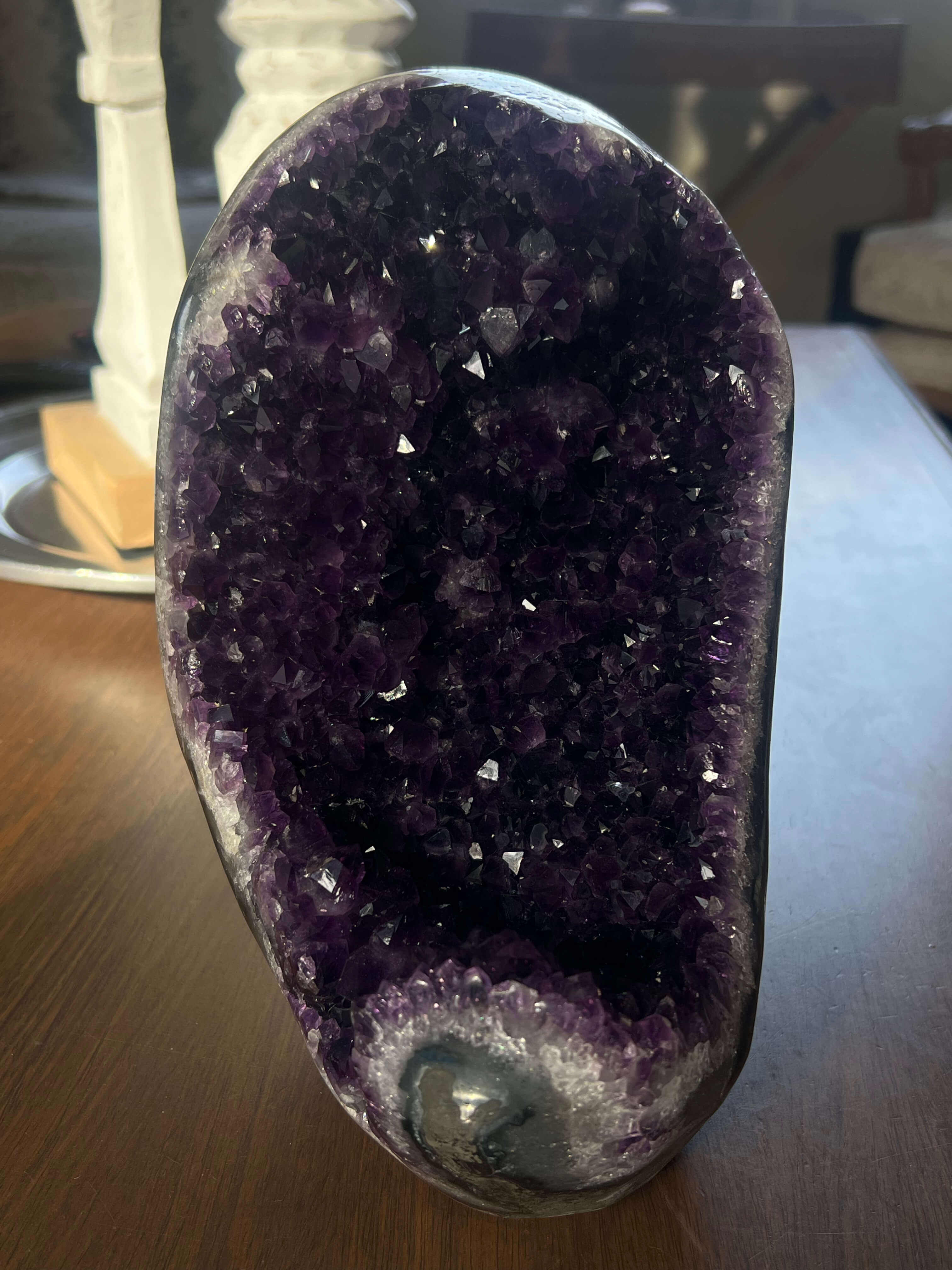
Choosing a specimen for a luxury interior is a decision about color, scale, and honesty of sourcing, and most buyers get at least one of those wrong on the first purchase.
Frequently Asked Questions
What type of amethyst is best for home decor?
For luxury home decor, look for deep purple amethyst from Artigas, Uruguay, graded Q1 or Extra AAA for color saturation and crystal clarity. Geodes and druses with polished agate borders work best as statement pieces on consoles, shelves, or coffee tables. Smaller hearts, domes, and specimen pairs suit desks and bedside tables. Prioritize natural color without artificial dyes or cement backing.
How do you choose a high-quality amethyst geode?
Check four things: color depth, crystal definition, finish, and provenance. Top-grade geodes show intense, evenly saturated violet with clearly formed points and no cloudy or broken crystals. The outer agate rim should be hand-polished, not painted. Ask for the origin (Artigas, Uruguay is the benchmark for dark amethyst) and confirm the piece is natural, without resin or cement fillers. Weight and height should suit your intended surface.
Where should you display a large amethyst cluster?
Place large clusters where they anchor a room without crowding it: a living room console, a dining sideboard, or a dedicated shelf with at least 20 cm of clearance around the piece. Keep them out of direct, all-day sunlight to protect color over time, and away from high-traffic edges. A stable, level surface matters more than height. For desks, choose smaller specimens so the crystal reads as an accent, not an obstacle.
How should a large amethyst specimen be packed for shipping?
Museum-grade specimens need rigid outer boxes, custom foam or molded pulp inserts, and crystal-safe inner wrapping that never touches the points directly. The piece should be immobilized so it cannot shift, with the heaviest section supported from below. Reputable sellers ship fully insured with tracked express couriers. Terrae Purpura dispatches from Tuscany with free shipping within the EU.
How do you clean and maintain an amethyst display piece?
Dust gently with a soft, dry brush or a microfiber cloth. For deeper cleaning, use lukewarm water with a drop of mild soap and pat dry immediately; never soak the agate base or use ultrasonic cleaners. Keep specimens out of prolonged direct sunlight, which can fade color over years, and away from radiators and humid bathrooms. Handle with two hands and place on a felt pad to protect polished surfaces.
