
Quick Summary
Verifying amethyst provenance means documenting the stone's chain from mine to buyer with written paperwork, not relying on appearance alone. Start by requesting a written origin statement naming the mining region, then ask for a gemological report and check its number in the issuing laboratory's database.
- Ask the seller to name the mining region in writing, not just the country.
- Check the gemological report number in the issuing laboratory's own database.
- Confirm the report's weight, dimensions and inclusions match the physical stone.
- Get a written statement on heat treatment, irradiation or dye before buying.
- Keep the report, invoice and seller statement together in one file.
Table of Contents
- Step-by-Step: How to Verify Amethyst Provenance
- Checklist and Professional Certification vs. DIY Testing
- Keeping Your Provenance Records for Your Next Purchase or Resale
- Frequently Asked Questions
Step-by-Step: How to Verify Amethyst Provenance
Last Updated: November 22, 2026
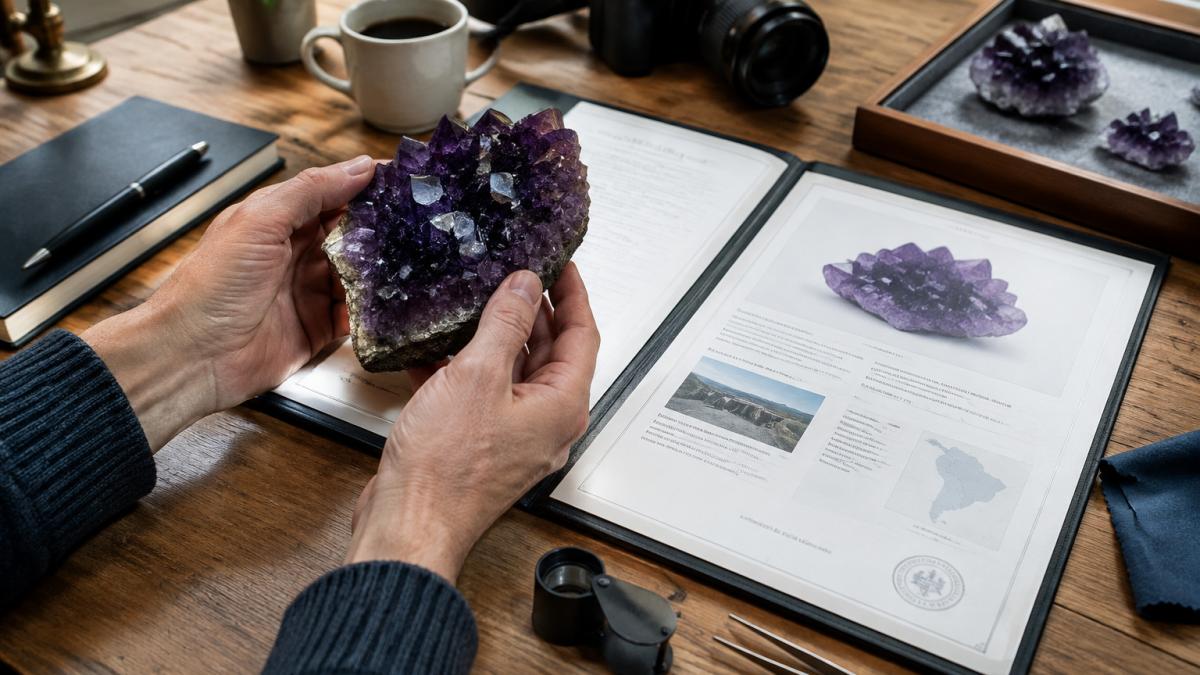
Verifying the amethyst provenance of a stone is harder than most buyers expect. Collectors who want proof of origin should know what that proof looks like. Provenance is the documented chain from mine to buyer. It rests on paper, not on looks alone.
Provenance is the recorded history of a stone's origin, handling, and ownership. A strong provenance file answers where the stone was mined, who cut and polished it, and whether it was treated.
The steps below work in order. Start with the seller's paperwork, then test the stone itself.
- Request the origin statement in writing. Ask the seller to name the mine region, not just the country, if the seller can provide it.
- Ask for a gemological report (gia.edu). Check the report number in the issuing laboratory's own database.
- Confirm the report matches the stone. Compare weight, dimensions, and any noted inclusions.
- Ask about treatments. Get a written statement on heat treatment, irradiation, or dye.
- Inspect visually. Learn how to tell if amethyst is dyed to rule out treated stones. Look for uneven color zoning, dye concentrated in cracks, or glass-like bubbles.
- Compare against a known reference. Use a trusted sample of Uruguayan amethyst if you have one.
- Keep every document together. Uruguay amethyst specimen buying guide covers what documentation to expect from sellers. Store the report, invoice, and seller statement in one file.
Watch out: A certificate that cannot be found in the issuing laboratory's database should not be relied on.
Checklist and Professional Certification vs. DIY Testing
A home checklist catches obvious problems. It cannot confirm origin. Use this checklist before any purchase:
- Seller names the mining region in writing
- Gemological report number is available
- Report details match the physical stone
- Treatment history is disclosed in writing
- Stone shows natural color zoning under good light
- No dye concentrations appear in cracks
Professional certification is generally the stronger test. A gemologist can examine a stone under magnification and assess its identity. A report explains what was tested and what was found, and it does not certify a specific mine, so ask the issuing laboratory directly what its report covers.
DIY tests suit first screening only. Learn how to identify museum grade amethyst to compare your findings against a higher standard. They should never replace laboratory work for a high-value purchase.
Use this checklist before any purchase, and note that a home checklist catches obvious problems but cannot confirm origin.
| Check | What to confirm | Why it matters |
|---|---|---|
| Mining region | Seller names it in writing | Establishes origin claim |
| Gemological report | Report number is available | Allows database lookup |
| Physical match | Details match the stone | Ties report to stone |
| Treatment history | Disclosed in writing | Reveals altered stones |
| Color zoning | Natural zoning under good light | Supports natural color |
| Cracks | No dye concentrations | Flags dye treatment |
Keeping Your Provenance Records for Your Next Purchase or Resale
Good records can support resale value, since buyers often ask for documentation.
Keep these items together:
- The gemological report and its report number
- The original invoice showing the seller's name
- Written statements on origin and treatment
- Photos of the stone with a reference scale
Update the file if the stone is cleaned, repaired, or re-set. Each change should carry a dated note. This habit makes future verification faster and keeps your collection's history clear.
Frequently Asked Questions
What does provenance mean for an amethyst specimen?
Provenance is the documented history of a specimen, from where it was mined to how it reached you. For amethyst, it covers the mining region, the cutting and polishing workshop, any treatment history and every change of ownership. Strong provenance rests on seller statements backed by paperwork rather than on the stone's appearance alone. Ask for records that name the source and the dates, and keep copies with the specimen.
Can a gemological report confirm an amethyst's country of origin?
A gemological report from an accredited laboratory identifies the stone as natural or synthetic and records its appearance and any treatments. It does not reliably determine the country of origin. Origin determination is limited and often rests on the seller's documentation. Treat a report as evidence of identity and quality, and treat origin claims as separate statements you verify through the documents and the seller's records.
Does a certificate of authenticity prove an amethyst's provenance?
A certificate of authenticity confirms that the seller claims a specimen is genuine, but it is only as reliable as the issuer. Check who issued it, whether the report number can be looked up in the laboratory's database, and whether it names the specimen clearly. A certificate alone does not prove origin. Pair it with purchase records and treatment disclosure before you rely on it.
